Welcome to our siteBojanala Kalafi Programme, registered name of U2R Associates UK Ltd a not-for-profit-organisation, company, limited by guarantee, registered in England & Wales No: 5019377 |
||||
BOSHOEK VILLAGE STORE 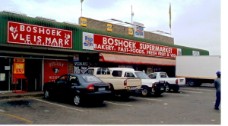 The Greater Rustenburg (Bojanala) District is situated within the North West Province, which is one of the poorest in South Africa with a provincial gross geographic (GGP) of £395 per person, which is well below the national average of £695. Rural poverty and rural urban income differences exacerbate social problems such as violence, crime and HIV/AIDS infection. The North West Province serves a population of 1.2 million people, of which 30% of the inhabitants reside in the urban Rustenburg area, and 70% of the population resides in rural and deep rural areas. 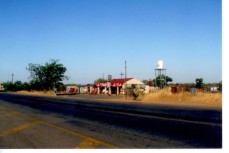 The estimated unemployment rate is 38% slightly higher than the average in South Africa and in real figures is approximately 577.000 with the female unemployment rate being above 50%. Some 30% of all the adult population is illiterate, the highest figure among all provinces in South Africa. More than 60% of households earn less than £100/150 per month. In addition, more than 80% of all households earn less than £300/350 per month. |
RUSTENBURG CITY CENTRE 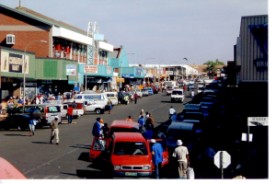 The poverty rate is approximately 52.7%. This figure is made up of 56.7% of the African population in poverty, 4.6% of the White population, 28.8% of the coloured population and 8.8% of the Asian population respectively.The main economic sector comes from an area rich in mineral resources with a number of mines operating in close proximity to the city of Rustenburg. Other economic activities undertaken in the region include agriculture of various forms, including tobacco, various dry land crops, citrus fruits, to a lesser extent, dairy farming and beef cattle. The mining activities attract a large number of migrant workers to Rustenburg, mainly from Lesotho, Mozambique and other parts of Southern Africa. This concentration of migrant workers has resulted in disruption to local communities and a breakdown of social, cultural and moral values in the absence of authority and structures. 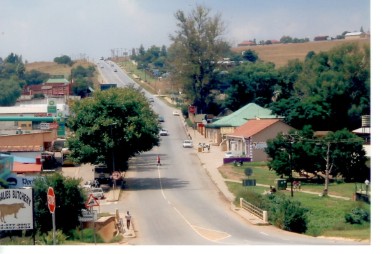 The result is the establishment and spread of overwhelming numbers of informal housing and indigent communities. As a consequence, the Greater Rustenburg (Bojanala) District exhibits a disproportional high HIV/AIDS infection rate in relation to the rest of the North West Province, borne out of data collected from the health center''s within the district and verified by the Provincial Department of Health. |
LEDIG VILLAGE HOUSE 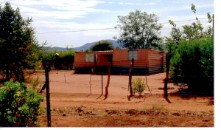 As a result of the dearth of this, many people living with HIV/AIDS are living below subsistence level and dying in conditions of poverty and squalor. This is attributed firstly to the lack of immediate or extended family that in some way is unable to care for the patient adequately and secondly to the prevailing economic and social conditions which mitigates against families being able to care adequately for the patient. Where such family structures are available, it is usually the breadwinner of the family who is infected, placing an intolerable limited access to services to assist them. 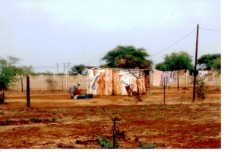 Overburdened health services, funded by both local government and provincial government, are unable to cope with the increased care expectations placed upon them and the HIV/AIDS patient has, consequently, no place to turn other than local under funded community HIV/AIDS projects for assistance or treatment to maintain quality of life and dignity. |
||
